My current research investigates the disease ecology of bird-parasite systems, particularly ticks. My past research focused on systematics and population genetics.
Population Structure of Amblyomma maculatum

Adult male Amblyomma maculatum
|
My master's thesis work assessed the population genetic structure of the Gulf Coast Tick (Amblyomma maculatum). This species and Amblyomma triste form a species complex of 4 nearly identical morphotypes. My research attempted to better delineate the relationship between morphotypes II and III. Morphotype II (A. maculatum sensu stricto) is found across the southeastern US and Atlantic Coast. Morphotype III (A. maculatum sensu lato) was discovered in southeast Arizona in 2014 and has since been found in and around the Sky Islands of the American southwest.
|
|
To assess the genetic structure I analyzed 6 microsatellite loci and discovered single nucleotide polymorphisms through ddRAD sequencing. This represented the first attempt to compare between microsatellites and SNPs for genotyping ticks.
We found strong evidence of genetic isolation between A. maculatum s.s. and A. maculatum s.l., with an estimated number of migrants at 0.07 per generation. STRUCTURE determined the optimal number of clusters to be 2, with a clear split between the eastern (s.s.) and western (s.l.) populations. This corroborates the crossbreeding study performed by Allerdice, et al. 2020, who found incomplete reproductive isolation between A. maculatum s.s. and s.l., indicating that the two represent distinct species. Within the eastern population, there was moderate genetic differentiation between subpopulations, but no signature of isolation-by-distance, indicating that the population fits the infinite island model of population differentiation, which would be consistent with rare, long-distance movements on migrating birds. |
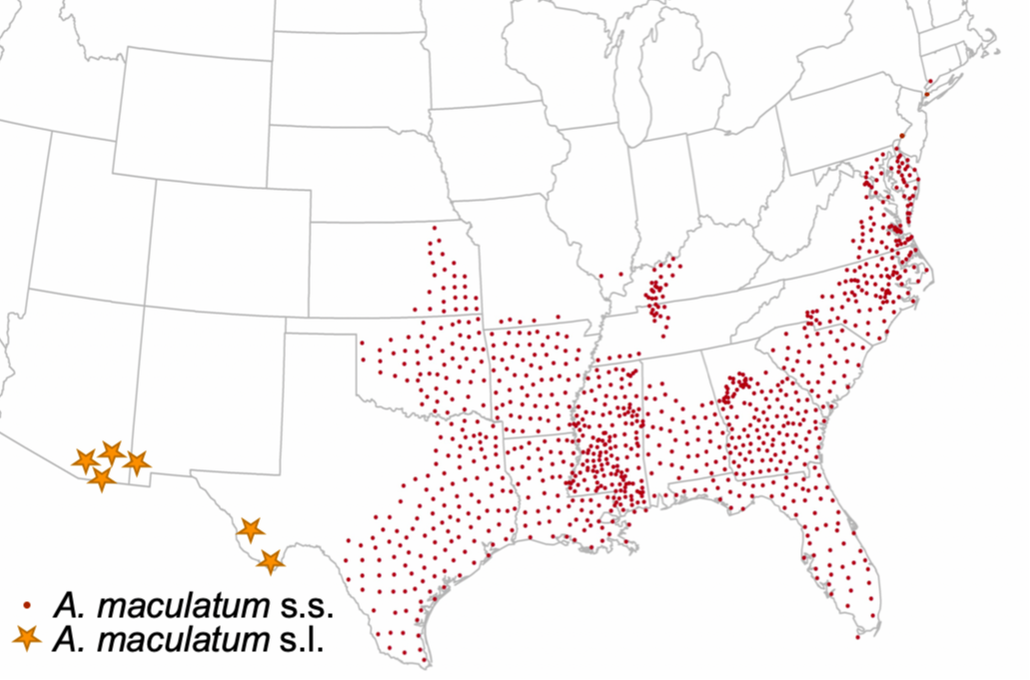
Distribution of A. maculatum in the US.
Modified from Molaei, et al. 2021
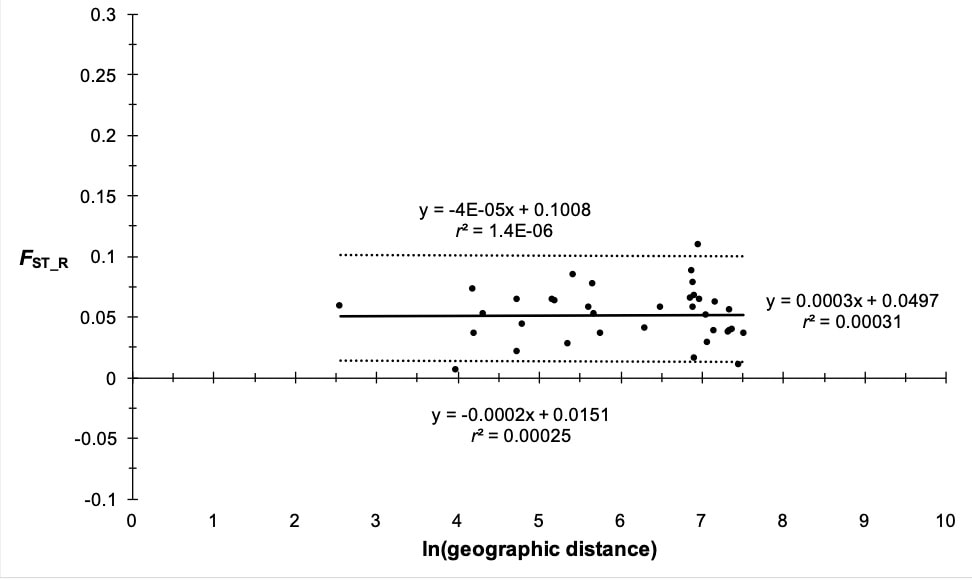
Regression of FST against the natural log of geographic distance between subpopulations in the east with 95% confidence intervals. Negligible r-squared and slope indicates no signature of isolation-by distance
|
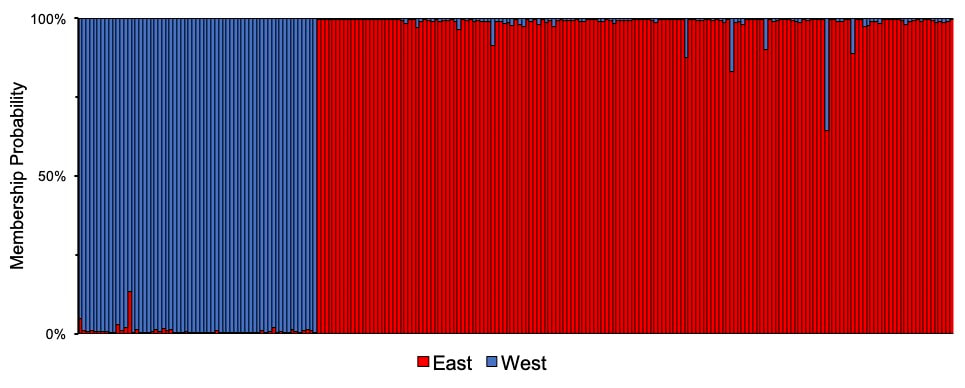
Results from STRUCTURE, with individuals aligned from west to east (based on collection location), showing clear differentiation between s.l. and s.s.
